Video: Making a tailstock dial indicator stop

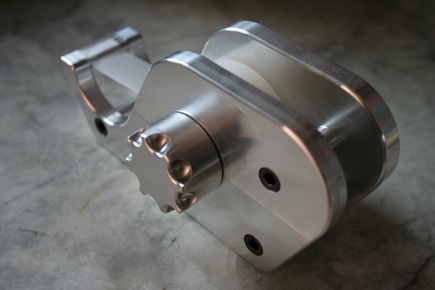
This short video shows you how to make a dial indicator stop for a Grizzly G0602 lathe that can be easily adapted to other lathes.  The stop is used with a magnetically mounted dial indicator to very accurately measure depth when drilling or boring.

You may find this video worth watching even if you don’t want to make a stop because it shows some unconventional ways you can use a lathe to do milling.

By the way, there is an easier way to make one.  You could just bore a hole in piece of metal to fit your quill and then add a setscrew to hold it in place.  But the setscrew will probably leave marks.  This stop is a little harder to make but it won’t do that because it clamps evenly around the quill’s circumference.

Solsylva 25x25 CNC Router Build


I’ve started building a CNC router from plans.  It’s something I’ve wanted to do for a long time now but I couldn’t decide how big a router to build or who had the best design.  This article describes why I want one and why I finally picked David Steele’s 25×25-inch dual leadscrew CNC router.  It’s a popular design you can probably build for $600 to $1200, depending on your choice of electronics and leadscrews.  The plans cost $25, or $35 if you buy them packaged with two of his other CNC router designs.  They’re available on his web site, Solsylva.com.

My choice was based on at least 25 hours of Internet research plus what I learned last month at a four-day CNC Workshop I attended in Ann Arbor, MI.  There are many router plans to choose from and it was difficult to determine who has the best design. I was strongly influenced by this router’s size, its popularity and the detailed information I found on the Solsylva web site.  But what clinched it was the many helpful builder’s logs I found, many of which detailed improvements you can make.

Here are some builder’s logs I recommend:

  • Crane’s 25×25 Solsylva Build w/ Pictures – This CNC newbie built a “stock” machine and in the process he got hooked on building CNC routers.   So then he built a heavily modified version using both his own ideas and those of other Solsylva builders.

Why a CNC router instead of a bigger CNC mill

I want to cut out, carve and engrave parts that would be too big for my CNC mini-mill or even Bridgeport if I had one.  A CNC router can’t machine metal as well as a mill but being able to cut out and shape large intricate parts out of wood, plastic and foam will make it possible for me to make all kinds of interesting and useful things.

I also think members of my family will want to use it and it’ll be fairly easy for them to learn how.  They’ll be able to make signs and cut parts out of flat stock using a “2.5D” CAM program that is much easier to use than the one I use with my CNC mini-mill.  They can also take advantage of some of the many free “almost ready to cut” DXF files you can find to make things like signs, toys and even furniture.

Size matters

I don’t have room in my very small workshop for a 4×8 or even a 4×4-foot CNC router.  They would also cost more and they probably wouldn’t be very suitable for a first build.

I almost decided to build a small moving-table type router, instead of one with a moving-gantry, because I’d be able to easily transport it to demonstrate or teach with.  They’re also the least expensive and easiest kind of CNC router to build.  But most of them are limited to making fairly small parts.  The ones I’ve seen that could easily fit in my car’s trunk usually have a working area of only about 12×12-inches or so, and that’s just too small to be very useful.

So I finally decided that I wanted a CNC router with a working area of at least 18×24-inches because it would be able to make most of the parts needed to reproduce itself or make an even bigger router.  The Solsylva design is a little bigger than that, with a working area of 25×25-inches.  And it includes plans for a table on casters that lets the router fold down so it takes up less room when it’s not being used.  It also serves as a work table you can build your router on.  If it’s too big or too small for you then take a look at their other designs.  They have plans for three other CNC routers with table sizes ranging from 10×9 to 24×48 inches.

Cost matters too
Continue reading → Solsylva 25×25 CNC Router Build

We got hacked (and I could use a little advice)

We got hacked Sunday morning.  Malicious code was added to our index files, Javascripts were replaced and file permissions were changed.  I noticed it almost right away and was able to fix it quickly.  But I had to delete all my WordPress plug-ins and I still haven’t finished reinstalling or reconfiguring some of them.  So some things may look different for awhile.

I think they got in via FTP and I’ve taken steps to block off that route.  But I would also like to do a complete reinstall of WordPress in case I have a security hole.  It looks like it’s an easy process but I’ve never done it before and I’m very afraid of somehow losing all my content.  I have backups but I also don’t have any spare time right now for fixing mistakes, especially big ones.

I’d really appreciate any advice you can give me about doing a reinstall or making MachinistBlog more secure.  You can leave a comment or email me at rr(at)machinistblog(dot)com.

One good thing did come from this.  I learned that I have a couple of plug-ins that are slowing down the web site significantly.  I’m going to look at whether they’re worth keeping or if there are better substitutes.

A Southbend movie about single-point cutting tools

I’m posting this video for a couple of reasons.  First, I often enjoy watching movies from this era and I thought some of you might too.  More importantly, it contains knowledge that is still true and useful more than 70 years later.